

The local election results were a triumph for Nigel Farage as well as being a modest success for Rupert Lowe. The Tories improved from 2025 levels but are still below those of 2024, so any optimism needs to be tempered. Beyond these headlines it is worth looking at the details of the national vote, and what that would have meant in terms of seats had it been a general election.
I have taken my figures from Thrasher and Rawlins, who have an excellent track record on converting local results into national ones, and published them in The Sunday Times this weekend. They calculate that if these results were replicated in a general election, then Reform would come top with 27% of the popular vote, with the Tories second on 20%. Labour is estimated to secure 15%, with both the Lib Dems and the Greens on 14%.
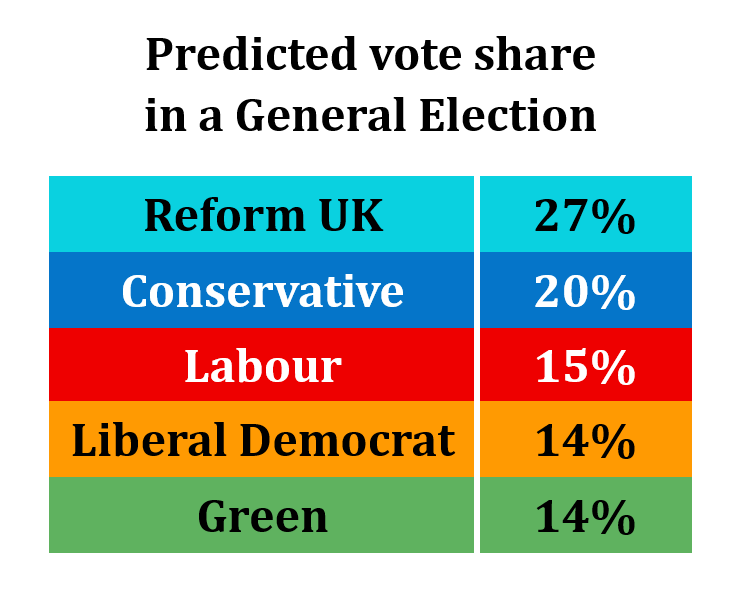
From these figures, no one party would have enough seats in the House of Commons to form a majority on its own. More importantly, even if by some fluke 27% were translated into a majority, it could never be a mandate. Sir Keir Starmer has clearly suffered from winning a mere 33% of the vote, in spite of his huge 170-seat majority. Although legally Parliament is sovereign, if a party has no mandate, it lacks the moral authority to pursue major change. Political reality is greater than the rules, because Parliament is made up of individuals and, especially in the Commons, MPs are conscious of the voters’ will.
This means that Starmer’s majority has been able to do very little as MPs are reluctant to support policies that are not popular in their constituencies. This is especially true for MPs with small majorities who feel that they cannot alienate any pressure group, however small. It is much easier to be brave with a majority of 20,000 than of 200. Thus, the vote share matters hugely for a party looking to be radical, which Reform has to be to fulfil its purpose. 27% or even 33% is simply not enough to achieve its ambitions.
However, in coalition with the Conservatives, this begins to change. Sky News forecasts that the local election results would have returned 284 Reform members and 96 Tories, so 380 altogether, or a majority of 110. This would be enough to put Nigel Farage into 10 Downing Street, and would create a stable, philosophically aligned government.
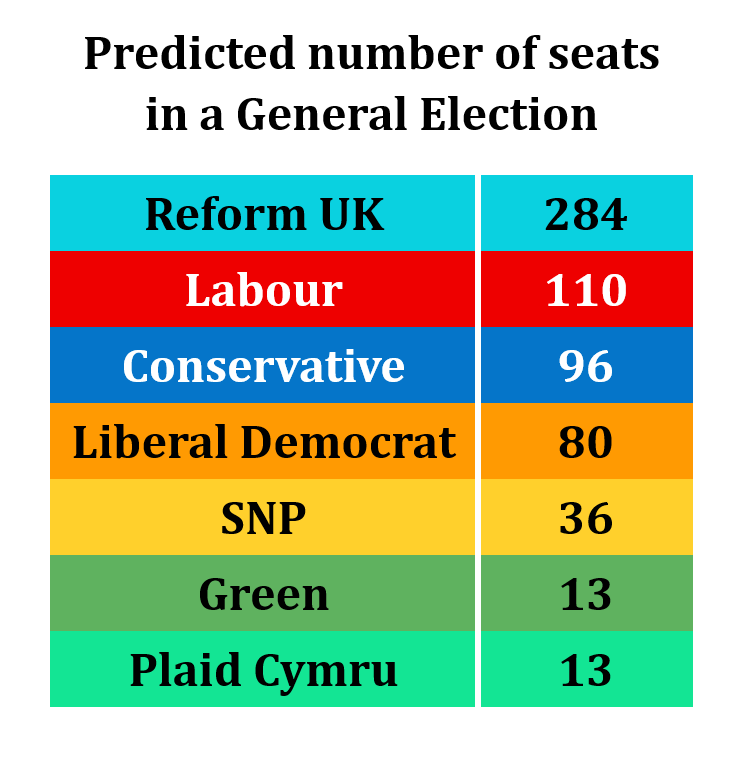
Consider the alternative. The only other majority would be if the Tories joined a rainbow coalition of Labour, the Lib Dems, the Greens and the Nationalists. This would be idiotic. A grand coalition to keep out Reform would simply not be supported by the majority of Conservatives, and would make the country feel cheated.
Hence, if it looks likely that the next election will produce a result that will lead to a Reform-Conservative coalition after the voting has taken place, why not prepare for it in advance? It is more honest, and offers the electorate a chance to vote for a unified platform agreed before the election, rather than a compromise cooked up afterwards.
It would give the new government a mandate for real change, which is sorely needed. As David Starkey has argued, there has to be a restoration. The constitutional clock needs to be put back to 1972 with government by the King in Parliament once again. The Supreme Court needs to be moved back into the House of Lords, and the Human Rights Act and membership of the European Convention of Human Rights must end. The Climate Change Act must be repealed, as must the 2010 Equalities Act and the Constitutional Reform and Government Act.
This needs a government with a large majority and a mandate for action, which the combination of the Tories and Reform would have. This would be enhanced by a pre-election deal, because the majority would be bigger and the electorate would know what to expect.
The logic of this seems compelling. It pre-empts the probable result where neither party is in a position to get to 40% on its own. Reform, for all its success, has not advanced from last year, and the Tories, even though Kemi Badenoch is the most popular leader of a party, is still polling at a lower level than in 2024.
This raises the question of what type of deal could be done, and there are historic examples. In the late 1880s, Conservatives did not oppose, in most cases, the Liberal Unionists, who then supported a Conservative administration. This was fairly informal and did not work in every constituency.
A better example is the 1918 coupon election, where Lloyd George and Bonar Law, for their respective parties, gave a letter of support or “coupon” to either a Lloyd George Liberal or a coalition Conservative candidate. Again, this did not work in all seats, but it held pretty widely and ensured that Lloyd George remained Prime Minister until 1922 on the back of Tory votes after the election.
In any coalition, it is worth learning one thing from David Cameron, which is that to make it work, the bigger party has to be generous. In this case, on current polls, Reform would be the bigger party. It would need to be generous by offering a coupon to all sitting Tory MPs. It would be invidious for a Tory leader to refuse a coupon to an incumbent, and although one or two existing and not very conservative Tory MPs might refuse, most would accept and it would create a basis for trust.
However, after this initial act of generosity, Reform would expect to win the bulk of seats in getting to the target of 325 and a majority. This would need to be done by analysing each seat to see who had the best chance. It is obvious that Reform can win in parts of the country where the Conservatives cannot. The Red Wall, where it has done so well in the recent local elections, is a clear example. It is also doing well in East Anglia and the Midlands. Any deal would have to recognise this, but equally, Reform’s chances in more Remain supporting areas are less good. So in Surrey and Oxfordshire, it would need to be a Conservative candidate.
Essentially, the two leaders would need to decide between them which seats each side would take. This would be helpful to Reform, which would then not need to find so many candidates, with the risk of selecting ones with reputational difficulties, which has been its besetting problem, as it is for all new parties.
To make this pact work, Tories must give up the silly nonsense of saying that Reform is not a right-wing party. For former members of a government which supported an earlier but equally left-wing version of the Renters’ Rights Act, this demands an ideological purity that they themselves never managed.
It is fanciful to think that only 20% of voters are basically Conservative, the 27% who support Reform are not left-wing, and those who assume they or their party hold such views are simply deluding themselves.
There are still a few tickets left for the last two shows of my Mogg, Unbuttoned tour.
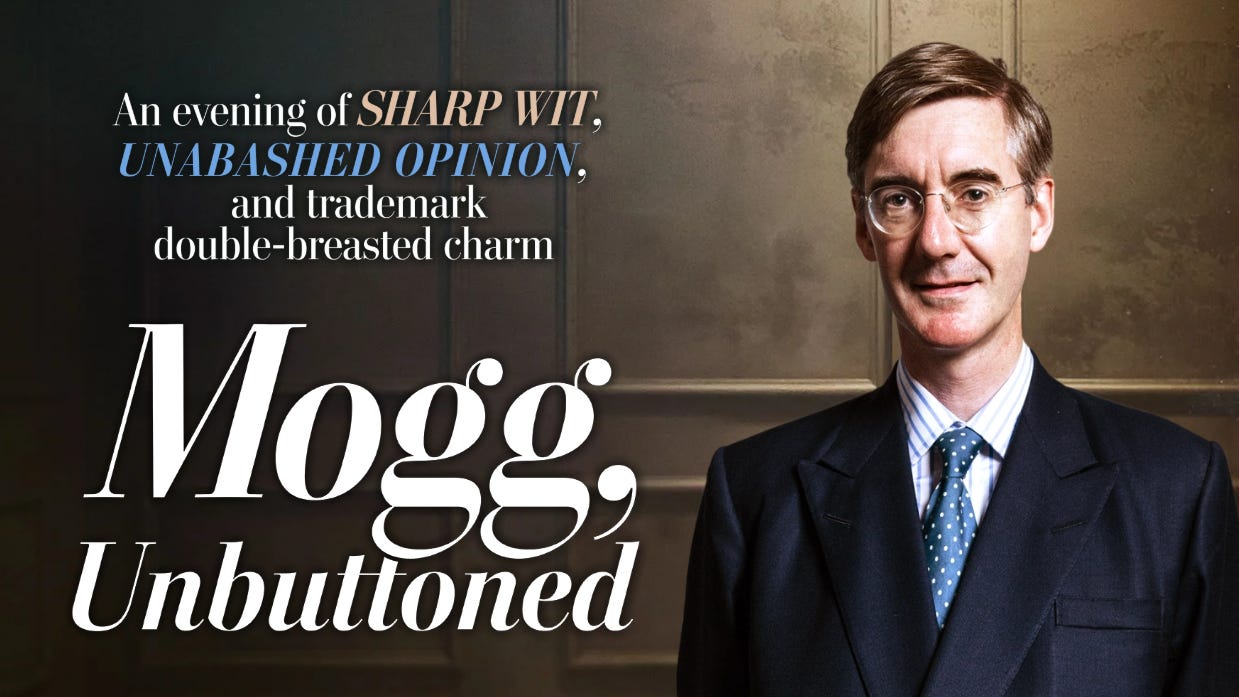
Tour dates:
Tue 19 May – Lincoln
Sun 24 May – Winchester
I would be delighted if you would join me — you can find out more and book your tickets at jacobreesmogglive.com.
You can now earn rewards by referring friends. For instance, if you can encourage three friends to subscribe, you will receive a month’s paid subscription. For more details please see the Leaderboard page.
Your comments would be most welcome. Please click the button to join the conversation. Thank you.


