

On Friday, I had the great privilege of visiting the Bayeux Tapestry at the British Museum with my mother. It is remarkable to see so old an object that has survived in such good condition.
Not that it is unchanged. The panel numbers were put in during the Napoleonic era, and the most famous arrow in history was added in the 1840s, even though there were apparently some stitch holes there already indicating something was in place before.
Information about the creation of the tapestry is essentially deduction, as it was not documented until 1476 when it first appeared in the inventory at Bayeux Cathedral. It is thought to have been made in Canterbury and is not in fact a tapestry, but an embroidery. It is believed to have been made by ladies, and its creators seemed to have been familiar with some manuscripts kept at St. Augustine’s Monastery. It is not known if the main figures portrayed looked like their pictures or whether, which is more probable, they were simply stylised images of power.
Nor is all the symbolism in the bottom panel fully understood. In the non-literate Middle Ages, symbolism was the commonplace way of transmitting knowledge, so every saint was depicted with a symbol, and the unlettered classes would have understood them easily. We do not have that good fortune.
Its size makes the tapestry of particular interest. It is seventy-five yards long, and that is without the conclusion – an unknown length at the end is missing – and its ability to tell a story is remarkable. It is an essay in history over two hundred and twenty-five feet, and it gives us an important insight into what has happened in the past, which fits with some of the constitutional essays I have written for Substack.
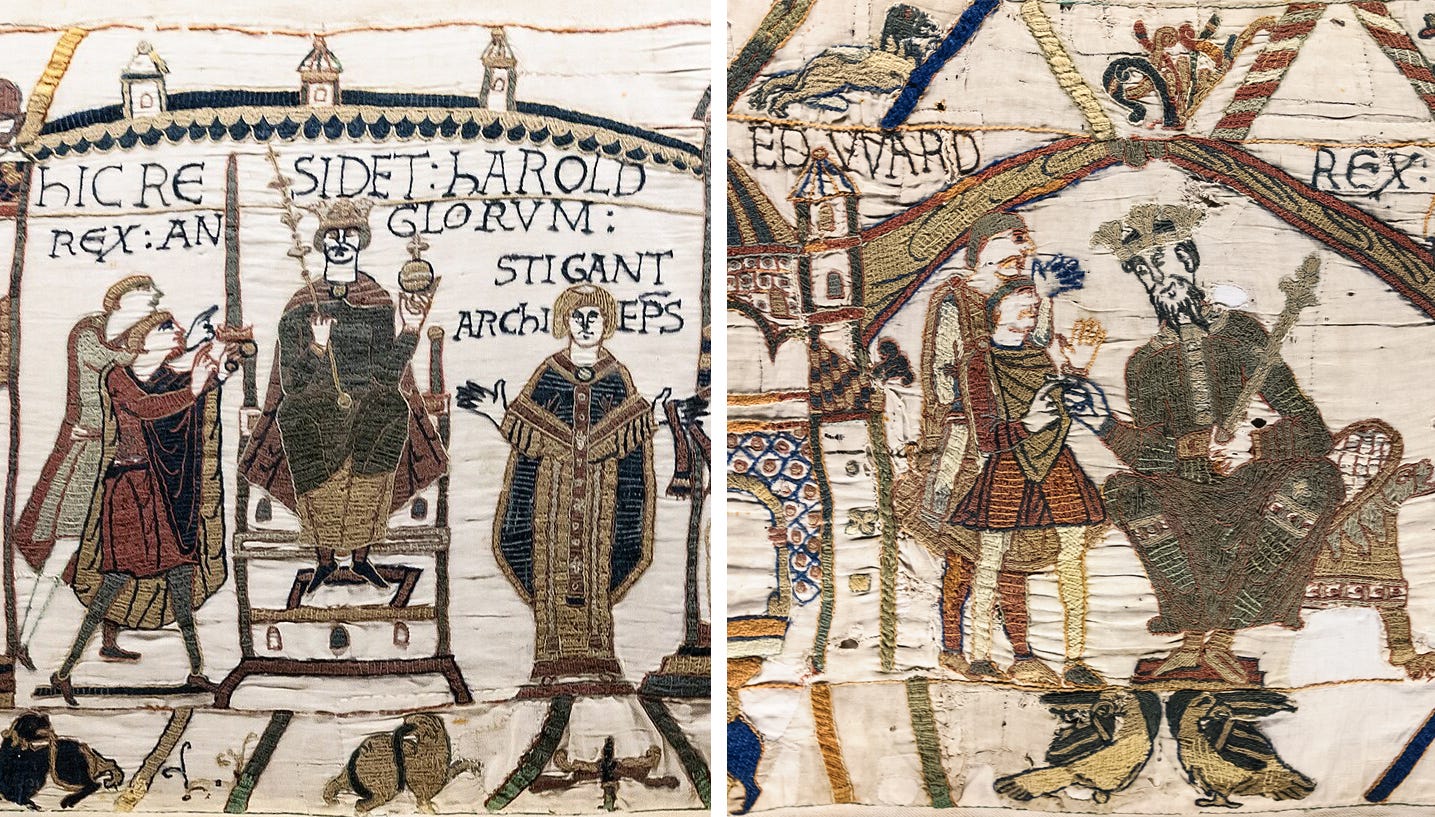
The tapestry tells a story of legitimacy that leads to success. It is in three parts, with the largest central panel dealing with the main narrative, while the top and bottom panels are decorated with symbolic figures. It is notable that in the panel showing the coronation of Harold, there is beneath it, in the lower panel, a creature identified by some as a griffin eating its own tail as a symbol of futility. By way of comparison, under Edward the Confessor there are two contented-looking birds. Edward is legitimate, Harold is not.
It is not entirely clear who ordered this work, but it is commonly linked to Odo of Bayeux, partly because he appears so prominently in some of the scenes, even in one of them as a Christ-like figure. He and his associates would have wanted to create an air of legitimacy around their new regime.


